
Minnesota Criminal Records
Minnesota criminal records are kept by several agencies across the state. The Bureau of Criminal Apprehension holds the central criminal history database, while court records are stored by District Courts in all 87 counties. You can search Minnesota criminal records online through the free Minnesota Court Records Online system, the BCA public criminal history site, or the Department of Corrections offender locator. This guide walks you through each system and shows you where to find local criminal records by county or city.
Minnesota Criminal Records Overview
Where to Search Minnesota Criminal Records
Three main systems give the public access to Minnesota criminal records. The Bureau of Criminal Apprehension runs the state's criminal history database. Minnesota Court Records Online covers District Court cases in all 87 counties. The Department of Corrections offender locator tracks current and recently released inmates. Each system covers a different slice of criminal history data, and knowing which one to use saves a lot of time.
The Bureau of Criminal Apprehension (BCA) is the main state agency for criminal history records. The BCA maintains the central repository for all Minnesota criminal history and runs the public Criminal History Site at chs.state.mn.us. A public search costs $8 per name. It shows conviction data for felonies, gross misdemeanors, and misdemeanors going back 15 years from the discharge date. The BCA is part of the Minnesota Department of Public Safety, which also oversees the State Patrol and other divisions.
Minnesota Court Records Online, often called MCRO, is a free public system run by the Minnesota Judicial Branch. You can search it at publicaccess.courts.state.mn.us. MCRO covers all 87 county District Courts and includes criminal, civil, probate, and family cases. For criminal cases, you can see party names, charges, case status, docket entries, and court dates. Documents filed after July 1, 2015, are available to download at no cost. The system also has a Judgment Search tab for civil judgments. No registration is required for basic case searches.
The Minnesota Department of Corrections Offender Locator lets you search for current inmates and offenders on supervised release. You can search by name or MNDOC offender ID. The results include offense details, sentence info, and anticipated release dates. This system only covers people committed to the Commissioner of Corrections, so it will not show county jail inmates or people on probation only.
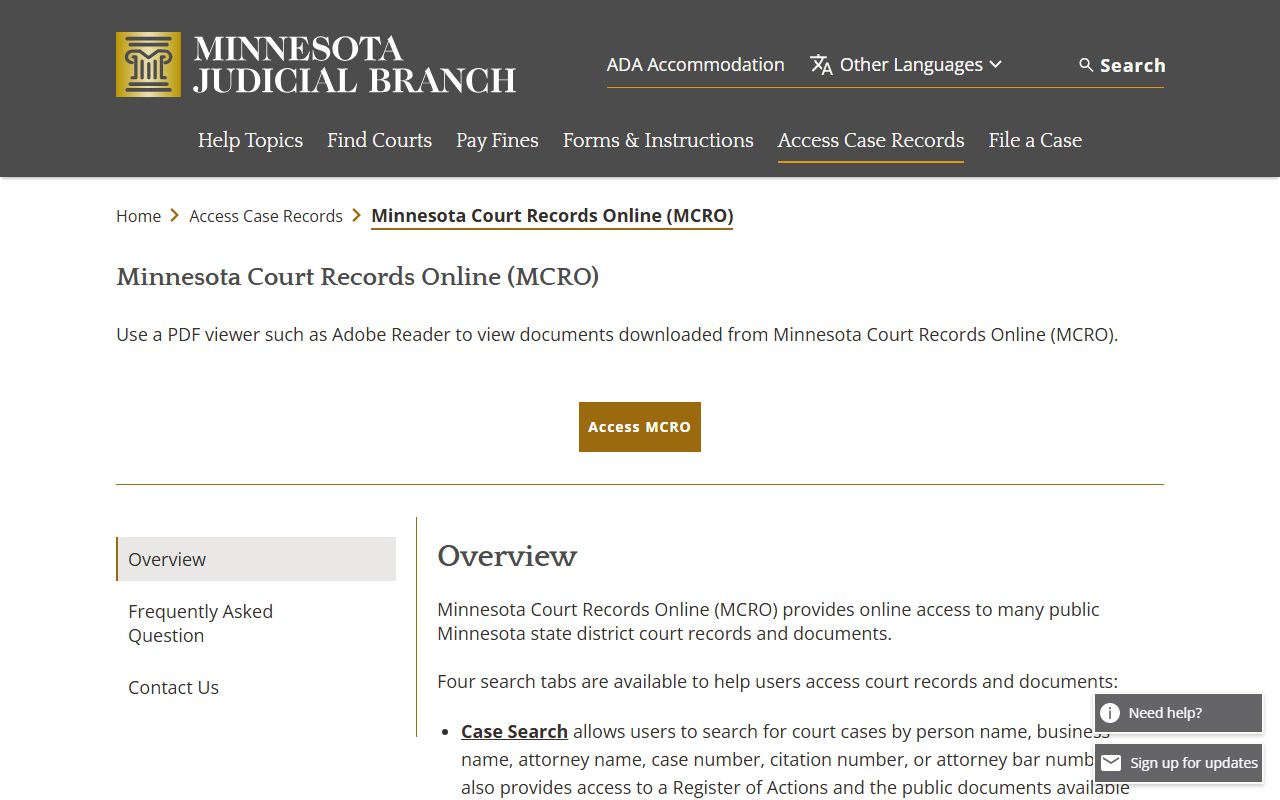
The Minnesota Judicial Branch explains what's available through MCRO, including document access rules and which case types are covered for public viewing.
BCA Criminal History Records in Minnesota
The BCA's public criminal history system is the state's official source for background check data. Under Minn. Stat. § 13.87, criminal history data is classified as private except for certain conviction data, which is public for 15 years following discharge of sentence. That public data includes the person's identity, the offense, the court disposition, and sentence information. Arrest data alone, without a conviction, is not public under this statute.
To use the BCA's public search, go to chs.state.mn.us and pay the $8 fee. You need the person's name and date of birth. The results show felony, gross misdemeanor, and misdemeanor convictions within the 15-year window. Records older than 15 years from the discharge date drop off the public view. Expunged records also do not appear. The BCA's central office is at 1430 Maryland Avenue East, St. Paul, MN 55106. Phone: (651) 793-2400.
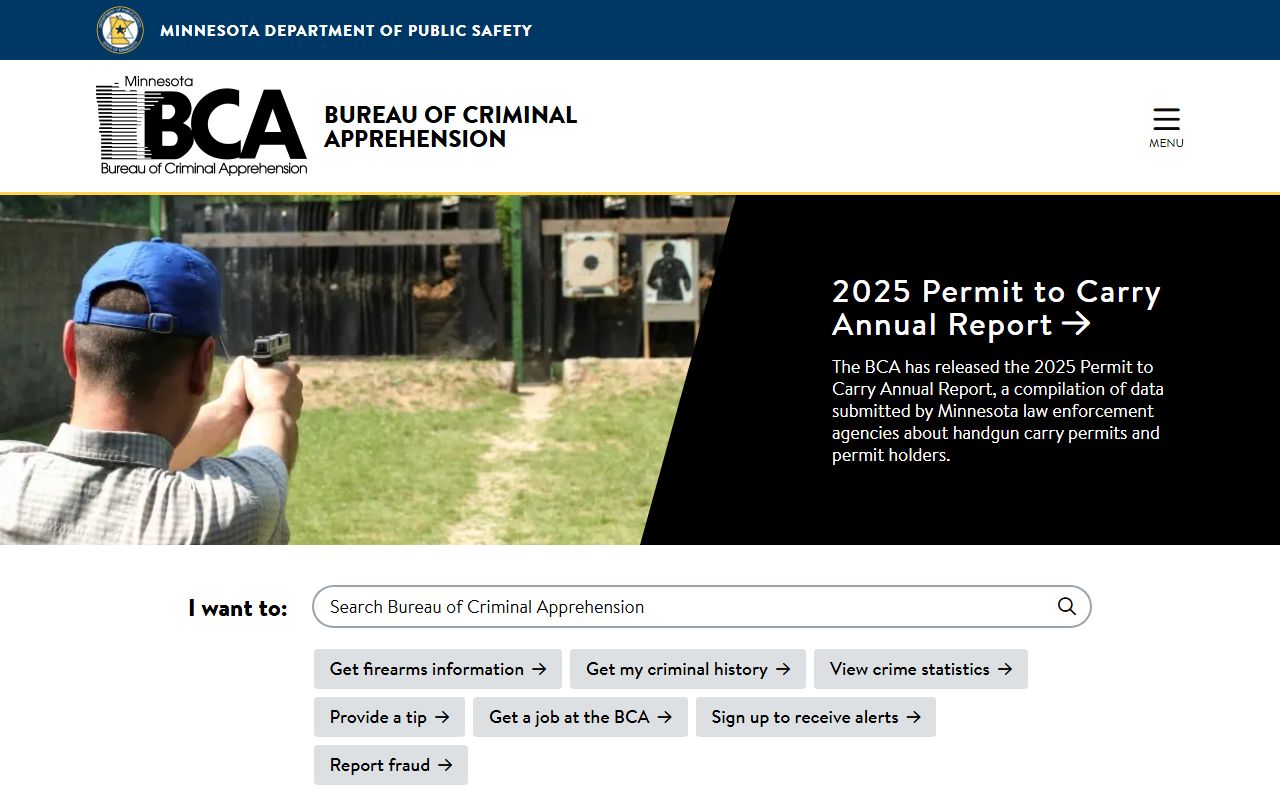
The BCA homepage describes the agency's role in criminal justice and links to its public criminal history search, forensic services, and investigative programs.
The BCA also maintains the predatory offender registry, manages forensic laboratories, and provides criminal justice training across the state. For in-person access to public criminal history data, you can visit the BCA office in St. Paul during regular business hours (8:00 am to 4:30 pm, Monday through Friday). In-person access to public conviction data is free under the statute requirements.
Minnesota Court Records Online (MCRO)
MCRO is the state's free public access system for District Court records. It covers criminal and civil cases filed in all 87 Minnesota counties. The system is in Phase 2 of a rollout that will eventually replace the older Minnesota Public Access system. You can search by person name, business name, attorney name, case number, or citation number. Search results show party names, case types, status, and hearing dates. For criminal cases, you can see the charges, court actions, and dispositions.
Documents filed after July 1, 2015, are available to download in PDF format at no charge. Court-authored documents from July 1, 2005, through June 30, 2015, are also available. Older documents are generally not in the online system. The MCRO system is available 24 hours a day, 7 days a week, with planned maintenance on Sundays from 9:00 am to 4:00 pm. You do not need to create an account to run basic searches, though account creation lets you save searches and receive notifications.
Some case types are excluded from MCRO's remote access. Under the Minnesota Rules of Public Access, the following are not viewable online: domestic abuse cases, harassment cases, civil commitment cases, juvenile delinquency cases for those 16 and older charged with felonies, and cases involving children in need of protection. For these restricted types, you need to visit the courthouse in person. The older Minnesota Public Access Remote system is still available for certain records but is being phased out.
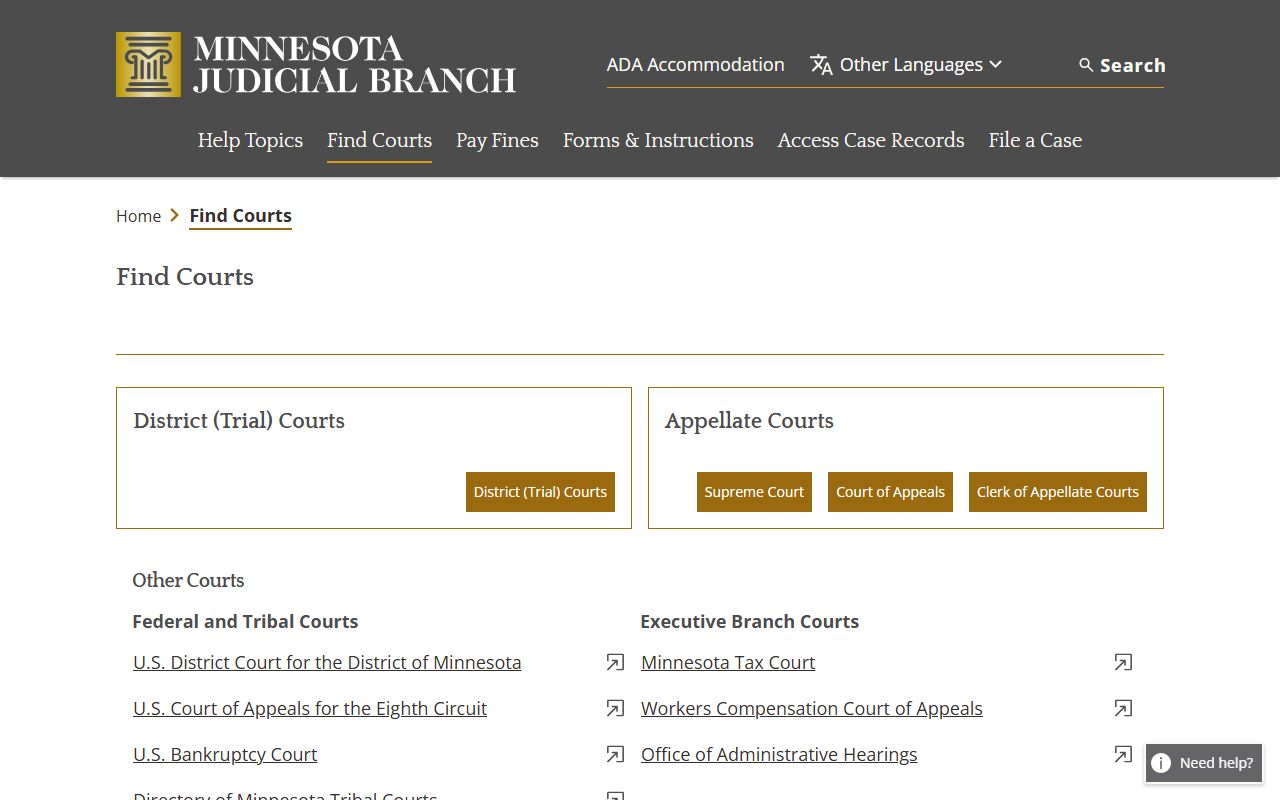
Use the Minnesota courts finder to locate the specific District Court for any of Minnesota's 87 counties, with contact details, hours, and local access options.
What Minnesota Criminal Records Are Public
Minnesota has detailed rules about which criminal records are public and which are not. The main law is the Minnesota Government Data Practices Act, found in Chapter 13 of the Minnesota Statutes. Under Minn. Stat. § 13.82, law enforcement data is divided into public, private, and confidential categories. Most people are surprised to learn that arrest data is largely public in Minnesota. When someone is arrested, the time, date, place, charges, resistance encountered, weapons used, and the identity of the arresting officer are all public data. Jail booking photos are generally public too.
Active criminal investigative data is confidential while the case is open. It becomes "inactive" when the case is closed through a decision not to prosecute, the statute of limitations expiring, or the exhaustion of all appeals. Once inactive, that data generally becomes public unless releasing it would harm another investigation or reveal protected identities. Victim names in certain cases, including sexual conduct offenses, may be withheld. Undercover officer identities and informant identities are also protected.
Some things stay private no matter what. Juvenile records are generally not public and are protected under Minn. Stat. § 260B.171. These records are kept separate from adult records and are not open for public inspection unless a court orders access. Juvenile court records are retained until the person turns 28, with extended retention if they later commit a felony as an adult.
Note: 911 audio recordings are private in Minnesota. Written transcripts of 911 calls are public, but the recordings themselves are not released under the Government Data Practices Act.
Expungement of Minnesota Criminal Records
Minnesota has two paths for sealing criminal records. The first is automatic expungement under Minn. Stat. § 609A.015, a law passed in 2023. The BCA identifies eligible records on its own and seals them without requiring the person to file a petition. Eligible categories include dismissals, diversion completions, and certain convictions after a waiting period. The wait is two years for petty misdemeanors and most misdemeanors, three years for most gross misdemeanors, and four to five years for certain felonies. This applies retroactively to qualifying offenses from before January 1, 2025.
The second path is a petition for expungement under Minn. Stat. § 609A.03. This requires filing a petition in District Court and serving it on the prosecutor and all affected agencies. The court holds a hearing no sooner than 60 days after service. The standard for granting the petition is clear and convincing evidence that the benefit to the petitioner outweighs any public safety concerns. Victims have the right to submit statements at the hearing.
Important to know: expungement in Minnesota means sealing, not destroying, records. Criminal justice agencies can still access sealed records for investigations. DNA samples are not sealed even after an expungement order. Under Chapter 609A, a Cannabis Expungement Board was also created to review felony cannabis offense records for resentencing or expungement.
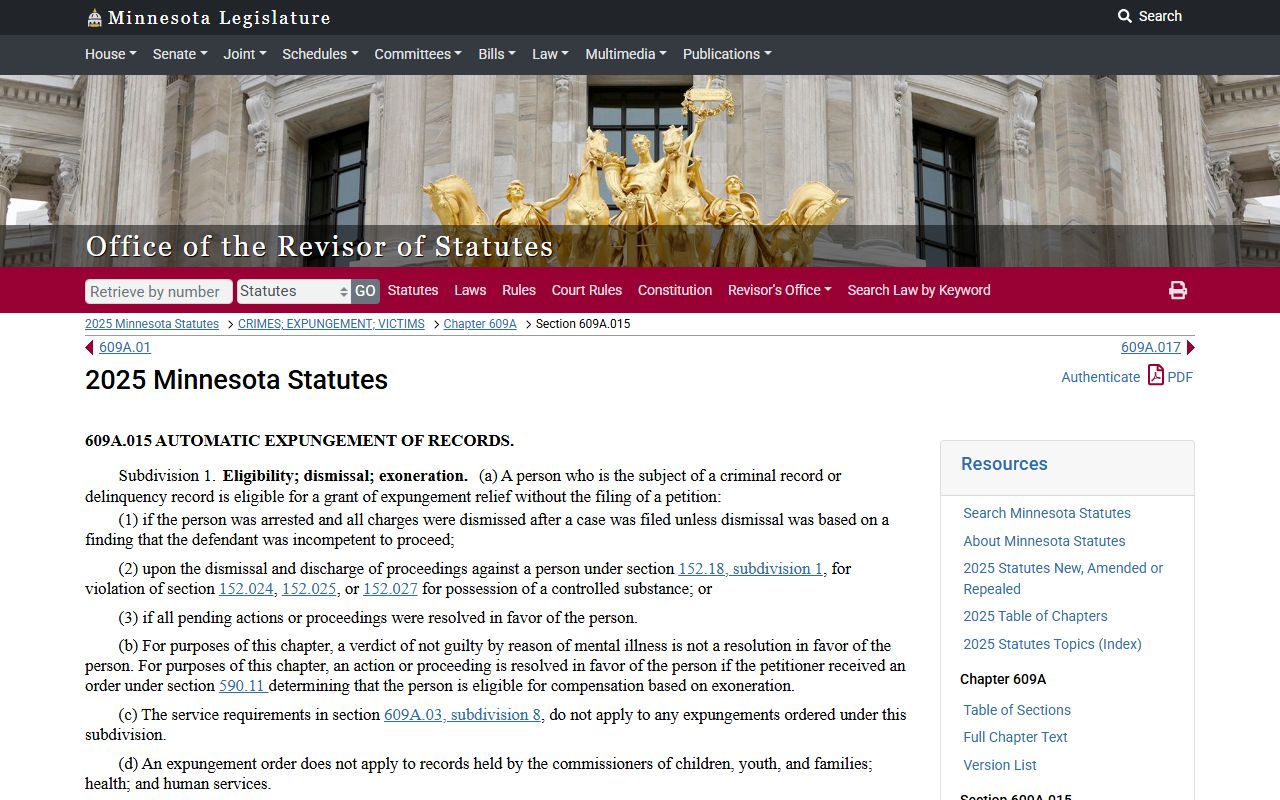
The full text of Minn. Stat. § 609A.015 outlines the eligibility rules and process for automatic expungement, including waiting periods and the BCA's notification obligations.
The Minnesota Judicial Branch also has a help page at mncourts.gov with self-help guides and information about the expungement process for people who want to file on their own.
Minnesota Predatory Offender Registry
Minnesota maintains a predatory offender registry under Minn. Stat. § 243.166. People convicted of certain sex offenses must register with law enforcement within five days of any address change. The registration period is generally 10 years, but lifetime registration applies for certain serious offenses or prior registration violations. Failure to register is a felony carrying up to five years in prison, with a mandatory minimum of one year and one day.
The Department of Corrections assigns risk levels to registered offenders under Minn. Stat. § 244.052. Level I is low risk and information stays within law enforcement. Level II is moderate risk and may be shared with schools and organizations serving likely victims. Level III is high risk and results in broad community notification, including posting on the DOC website. You can check Level III offenders through the Department of Corrections offender search. The Minnesota Attorney General's Office handles legal proceedings related to civil commitment of the most dangerous predatory offenders.
Browse Minnesota Criminal Records by County
Each of Minnesota's 87 counties has its own Sheriff's Office, jail, and District Court handling criminal cases. Select a county below for local contact info, jail roster access, and resources for criminal records in that area.
Criminal Records in Major Minnesota Cities
Major Minnesota cities have their own police departments that maintain local criminal records. Select a city below for police department contact info and local criminal record resources.